
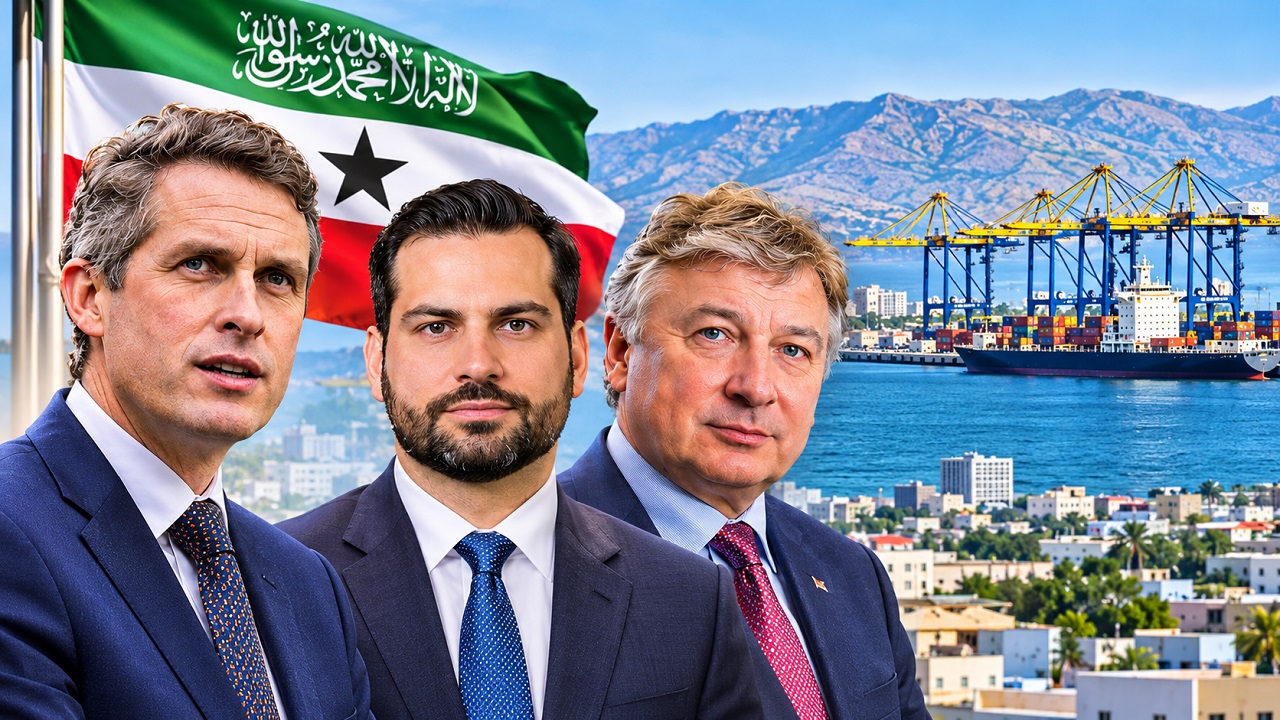
A new article by three influential figures with political and policy connections in the UK and international circles argues that Somaliland’s experience raises difficult questions about how the international community approaches statehood, sovereignty and self-determination.
The debate over Somaliland’s recognition is increasingly taking a different direction, with some international commentators shifting their focus from whether Somaliland has established a functioning state to why its political reality remains largely unacknowledged by the international community.
In a new article published by International Policy Digest, Sir Gavin Williamson, Bennett Iorio and Alexander Temerko argue that Somaliland’s experience exposes a contradiction in the international system, which frequently emphasises stability, democratic governance and self-determination but remains reluctant to reconsider established political arrangements.
The article, titled “Somaliland Has Built a State. The World Won’t Recognize It,” makes the case that Somaliland should no longer be treated simply as an unresolved political question. Instead, the authors argue that its experience raises broader questions about how the international community assesses claims to statehood.
The authors bring different backgrounds to the discussion. Williamson served in several Cabinet positions in the British government, Iorio is a geopolitical adviser with experience in international policy circles, while Temerko is a British business figure with political and commercial connections.
A different argument for recognition
Somaliland’s case for international recognition has traditionally centred on its history, the restoration of its independence in 1991, its political institutions and its record of maintaining relative stability in a region frequently affected by conflict and political uncertainty.
The latest article takes a slightly different approach, questioning why the international system has not developed a more credible process for examining claims to statehood where political realities have evolved over time.
The authors point to Somaliland’s ability to maintain its own institutions, security structures, currency and electoral system for more than three decades, despite operating without formal international recognition.
They also highlight Somaliland’s political transitions, including the November 2024 presidential election, in which the incumbent won and power was transferred peacefully.
For the authors, such developments demonstrate that Somaliland’s political experience deserves more serious consideration than it has received from international policymakers.
Their argument is not simply that Somaliland deserves recognition, but that the international community needs a more consistent way of assessing cases involving self-governance, political legitimacy and competing claims to sovereignty.
The economic consequences of non-recognition
The article also examines the economic cost of Somaliland’s international status, arguing that the absence of recognition can make investment, financing and international commercial relationships more difficult.
Somaliland has spent years trying to develop Berbera into a major regional trade and logistics centre. The expansion of Berbera Port, supported by investment from DP World, has strengthened its potential to connect regional markets, particularly Ethiopia, with international maritime routes.
However, the authors argue that Somaliland’s economic ambitions are constrained by the uncertainty surrounding its political status. They suggest that non-recognition can affect investor confidence, financing arrangements, insurance costs and the ability to undertake long-term infrastructure projects.
The article says that Recognition would not necessarily eliminate these challenges, but greater access to international institutions and financial systems could create opportunities that are currently difficult to pursue.
The argument places Somaliland’s recognition debate within a wider economic context, suggesting that the issue has consequences beyond diplomacy and international politics.
The dilemma facing the international community
One of the article’s central arguments is that international policymakers continue to face a difficult balance between territorial integrity and self-determination.
Many governments are reluctant to support changes to established borders, fearing that doing so could encourage other territorial disputes or create instability. Somaliland, however, has maintained that its case is different, arguing that its independence in 1960, subsequent union with Somalia and restoration of independence in 1991 provide a distinct historical and legal basis for its claim.
They propose a more structured international approach to evaluating claims to statehood, potentially considering factors such as sustained public support, institutional capacity, protection of minorities and the ability to resolve disputes peacefully.
Such a framework would not automatically lead to recognition, but it could provide a clearer basis for examining cases like Somaliland’s.
Somaliland’s strategic position adds to its relevance
Somaliland’s location along the Gulf of Aden, near the entrance to the Red Sea and major international shipping routes, has increasingly attracted attention from governments, businesses and geopolitical analysts.
The development of Berbera Port and Somaliland’s ambitions to expand regional trade and connectivity have added to its strategic importance, particularly as international attention to maritime security in the Red Sea and the Horn of Africa continues to grow.
The authors argue that Somaliland could play a greater role in regional security, maritime cooperation and trade if it were more closely integrated into international partnerships.
They also suggest that Somaliland should continue expanding cooperation in areas such as trade, education, transport, science and professional standards, even where formal diplomatic recognition remains unavailable.
This approach suggests that international engagement need not be limited to the question of recognition. Somaliland could continue building relationships and pursuing practical cooperation while maintaining its broader diplomatic objective.
A debate that is gaining a different dimension
The article does not suggest that recognition would solve every challenge facing Somaliland. Questions of governance, political inclusion, accountability, economic development and territorial disputes remain important.
But its argument reflects a broader shift in how some international figures are approaching Somaliland’s case.
Rather than focusing exclusively on the historical and political arguments for independence, the discussion is increasingly centred on the consequences of leaving a functioning political system outside the formal structures of international recognition.
After more than three decades of self-governance, Somaliland’s case is raising questions that extend beyond its own borders: how should the international community respond when political realities evolve in ways that existing diplomatic frameworks struggle to accommodate?
The challenge remains securing Somaliland recognition. But the debate surrounding that objective is increasingly moving into wider discussions about sovereignty, international consistency, economic opportunity and the future of the political order.