
A new study by the International Institute for Religious Freedom outlines 12 legal, historical and political arguments for Somaliland’s sovereign statehood, highlighting its independence in 1960, democratic record and the circumstances surrounding the collapse of its union with Somalia.
Hargeisa (SLpost)- A new international report has presented a detailed legal and political argument for recognising Somaliland as a sovereign state, arguing that its 1991 declaration of independence should be understood as the restoration of previously recognised statehood rather than an attempt to break away from an existing country.
The report, titled The Case for Somaliland’s Sovereign Statehood: A Consolidated Argument, was written by Professor Thomas Paul Schirrmacher, president of ISHR and published by the International Institute for Religious Freedom (IIRF) as part of its 2026 report series.
Published on October 19, 2026, the 15-page study brings together 12 arguments covering Somaliland’s historical status, international law, democratic institutions, security record and strategic importance in the Horn of Africa.
The International Society for Human Rights (ISHR), which also published an overview of the report on November 6, described its central argument as the resumption of an interrupted sovereignty rather than secession.
Somaliland’s 1960 independence at the centre of the argument
One of the report’s main arguments is based on Somaliland’s separate independence on June 26, 1960, when the former British Somaliland Protectorate became an independent state.
According to the study, Somaliland received recognition from 35 countries, including the United Kingdom and the United States, before voluntarily entering into a union with the former Italian-administered territory of Somalia on July 1, 1960.
The report confirms that the union did not have a fully established legal foundation, citing legal scholarship which maintains that the Act of Union was never properly ratified under the constitutional procedures of both sides.
Schirrmacher writes that when the union collapsed in 1991, Somaliland returned to its previously recognised boundaries and resumed its separate statehood.
The study compares Somaliland’s circumstances with those of Estonia, Latvia and Lithuania, whose independence was restored in 1991 following decades of Soviet annexation.
It also refers to the dissolution of the Senegambia Confederation in 1989, when Senegal and The Gambia returned to their previous separate status after a political union between the two countries ended.
These examples are used to support the argument that Somaliland’s case should be examined through the principle of state continuity rather than treated as an ordinary secession movement.
International law and the question of recognition
The report also examines the legal requirements for statehood under the 1933 Montevideo Convention, which identifies four main criteria: a permanent population, a defined territory, an effective government and the capacity to establish relations with other states.
Schirrmacher argues that Somaliland meets all four requirements.
The study points to Somaliland’s established population, defined territory, functioning government institutions, courts, police, currency and taxation system. It also highlights its ability to maintain external relations, establish diplomatic contacts and pursue international trade agreements.
Another important argument concerns the African principle of maintaining colonial-era borders, known as uti possidetis juris.
The report argues that recognising Somaliland would not require the creation of new borders or the transfer of territory from another country. Instead, it would recognise the boundaries of the former British Somaliland Protectorate, which became independent in 1960.
This argument directly addresses concerns that recognising Somaliland could encourage other separatist movements or undermine territorial stability in Africa.
The author also refers to the International Court of Justice’s 2010 advisory opinion on Kosovo, which concluded that international law does not generally prohibit declarations of independence.
The report argues that Somaliland has an additional historical basis because it had already existed as an internationally recognised independent state before entering the union with Somalia.
It further maintains that diplomatic recognition of Somaliland would not, in itself, violate Article 2(4) of the United Nations Charter, which prohibits the threat or use of force against the territorial integrity or political independence of states.
These are the author’s legal interpretations and arguments, rather than a binding ruling by an international court on Somaliland’s status.
Historical injustices and the right to self-determination
The study also places considerable emphasis on the 1988 and 1989 massacre, when the military government of former Somali President Mohamed Siad Barre launched devastating attacks on Hargeisa and Burao.
The report points out that aerial bombardments and military operations killed tens of thousands of Isaaq civilians and destroyed large parts of both cities.
Schirrmacher argues that these events provide an additional basis for Somaliland’s independence under the principle of remedial self-determination.
This principle concerns the right of a population to seek independence as a last resort when it has suffered serious and sustained human rights violations and peaceful alternatives have been exhausted.
The report maintains that Somaliland’s 1991 declaration was not simply a response to the collapse of the Somali central government but also followed a history of severe human rights abuses against its population.
Democratic governance and regional security
Somaliland’s political and security record forms another major part of the report’s argument.
The study highlights the Somaliland’s experience of competitive elections, peaceful transfers of power and the development of functioning political institutions despite the absence of widespread international recognition.
It specifically refers to the 2003 presidential election, which was decided by a margin of just 80 votes. The defeated candidate peacefully accepted the result, an example the report uses to illustrate Somaliland’s democratic development.
The author contrasts this experience with the continuing political and security challenges facing Somalia.
The report also highlights Somaliland’s efforts to combat piracy and terrorism, arguing that its security institutions have contributed to regional stability.
It presents Somaliland as a potential partner for international governments seeking cooperation on maritime security, counterterrorism and the protection of important trade routes.
Berbera port and Somaliland’s strategic importance
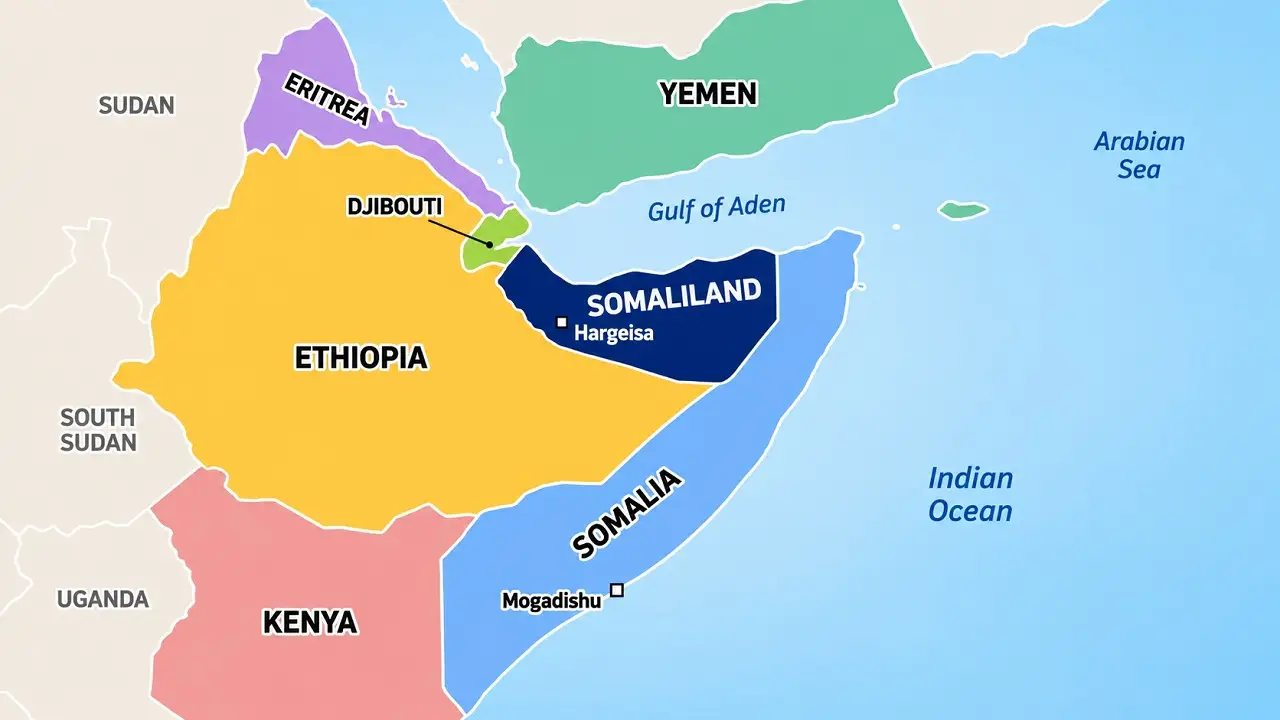
The report gives particular attention to Somaliland’s geographical position along the Gulf of Aden and the strategic importance of Berbera Port.
It identifies the Berbera corridor as a potential alternative trade route for landlocked Ethiopia, which the study says currently routes approximately 95 per cent of its foreign trade through Djibouti.
The report says that access to Berbera could help Ethiopia diversify its trade routes and reduce dependence on a single maritime gateway.
It also highlights investment by DP World in the port, including a 30-year concession and investment of up to $442 million, which has significantly expanded Berbera’s container-handling capacity.
The writer says that international recognition could also give Somaliland greater access to international financing, security cooperation and opportunities to develop its economic infrastructure.
Israel’s recognition and growing international debate
The report identifies Israel’s formal recognition of Somaliland in December 2025 as an important development in the international debate over Somaliland’s status.
Israel became the first United Nations member state to formally recognise Somaliland, bringing renewed international attention to the question of its sovereignty.
However, the decision also generated significant opposition.
At an emergency United Nations Security Council meeting on December 29, 2025, 14 of the Council’s 15 members spoke against Israel’s recognition. The African Union and the Intergovernmental Authority on Development (IGAD) also criticised the move, describing it as premature and potentially destabilising.
The study acknowledges these objections but argues that political opposition should be distinguished from the legal question of whether individual countries can recognise Somaliland.
It also notes that the United States administration has not followed Israel’s decision, despite growing interest in Somaliland within the US Congress.
Growing interest in Washington and London
The report identifies increasing political attention in the United States and the United Kingdom as another indication that Somaliland’s international status is becoming a more prominent policy issue.
In Washington, it highlights efforts by Senator Ted Cruz to encourage the US government to recognise Somaliland, citing its strategic position, counterterrorism cooperation and potential importance to American security interests.
It also refers to legislation introduced by Representative Scott Perry seeking Somaliland’s recognition, alongside congressional interest in strengthening relations with Hargeisa.
In the United Kingdom, the report points to debates in the House of Lords, where several members have supported closer engagement with Somaliland and raised the question of international recognition.
However, the study acknowledges that political support remains divided and that neither the US administration nor the British government has adopted a formal policy of recognising Somaliland.
A legal and political debate that remains open
In its conclusion, the report presents Somaliland’s case as a combination of historical continuity, international legal principles, democratic governance and strategic importance.
Its central argument is that Somaliland should not be viewed simply as a territory seeking separation from Somalia, but as a former independent state seeking the restoration of its sovereignty following the collapse of a union.
However, the report provides another international platform for presenting Somaliland’s historical experience, constitutional development and arguments for sovereign statehood to policymakers, researchers and the wider international community.