
CCTV footage sparks debate over police powers, arrest procedures and the use of force after officers target an electricity company executive.
Hargeisa (SLpost) – A CCTV video showing several men arriving in civilian vehicles and attempting to stop the manager of Indho-Birta Power Company has sparked public debate over police powers, arrest procedures and the use of force in Somaliland.
The incident, which took place at night as the businessman was returning home from his office, was initially seen by many people as a possible kidnapping attempt by unidentified individuals, as shown in a viral CCTV footage shared on social media.
However, the Somaliland Police later confirmed that its officers had carried out the operation. According to a statement posted on the official Facebook page of the police, the officers were attempting to arrest the company manager after he allegedly ignored a summons from the Criminal Investigation Department (CID).
The police said the operation was connected to the company’s alleged failure to comply with a presidential directive regulating electricity prices.
Despite the police explanation, the incident has raised serious questions about whether the operation followed proper legal procedures.
What does the CCTV footage show?
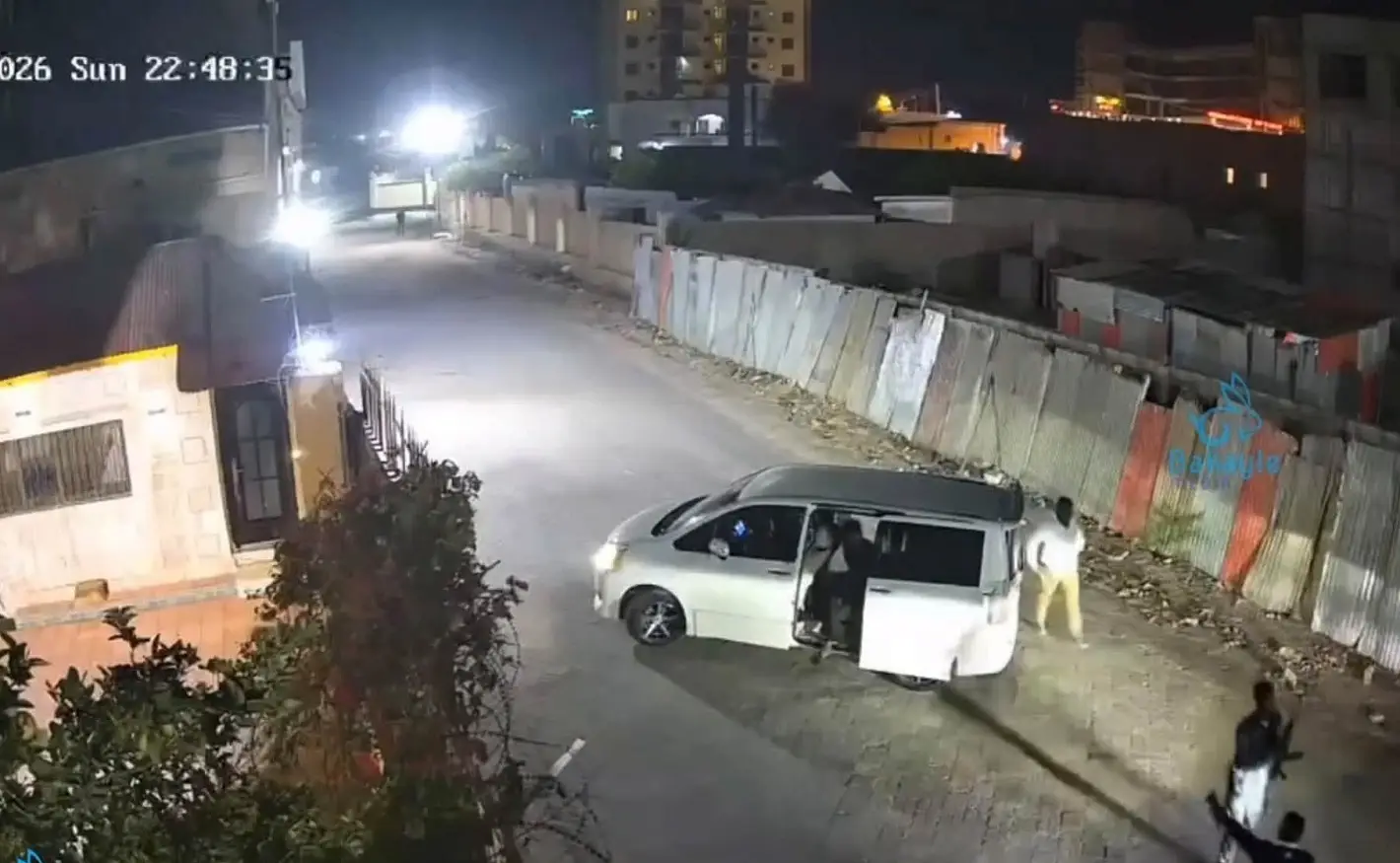
The viral CCTV footage shows a white Toyota Noah stopping near the businessman’s vehicle stopped in front of his home. Several men then approach the vehicle and attempt to open its doors.
According to voices being heard from the footage, the men ordered the businessman to get out of his car.
The driver refused to comply and instead reversed his vehicle before driving away.
The audio from the video also appears to capture individuals saying, “Shoot him, shoot him,” followed by what sounds like a gunshot. Some of the men then appear to return to their vehicle and pursue the departing car.
Police admit carrying out the operation
In a statement, the Somaliland Police confirmed that their officers carried out the operation.
The police referred to Article 15(4) of the Somaliland Police Law, saying the operation was conducted as part of their legal responsibilities.
According to the police, some electricity companies had refused to respond to summonses from the Criminal Investigation Department. They also accused the companies of violating the President’s directive on electricity prices and instructions issued by the Somaliland Energy Commission.
The police rejected reports about the incident that they said did not reflect the actual circumstances of the operation.
However, the statement did not provide detailed information about whether an arrest warrant had been issued, why the operation was conducted using civilian vehicles or whether the use of firearms had been authorised.
These unanswered questions have become central to the public debate.
What does Somaliland law say about arrests?
Article 25 of the Somaliland Constitution protects individual liberty and sets legal limits on arrest and detention.
The Constitution provides that a person cannot be deprived of liberty except in accordance with the law. It also sets conditions under which a person may be arrested, including cases involving a court-issued arrest warrant or specific circumstances permitted by law.
Article 26 protects the principle that a person accused of a crime is presumed innocent until proven guilty by a competent court.
This raises an important question to be asked: Was there a valid arrest warrant for the manager of Indho-Birta, or did the police rely on an exception that allows arrests without a warrant?
Not every arrest without a warrant is automatically unlawful. The law may allow such arrests in specific circumstances. However, the police must be able to explain the legal grounds for taking that action.
Ignoring a police summons does not, by itself, automatically establish that all legal conditions for an arrest without a warrant have been met.
The police also need to distinguish between investigating a suspected violation and arresting an individual. These are separate legal steps and must each have a proper legal basis.
Police powers do not remove legal limits
The police have a duty to investigate suspected crimes, maintain public order and enforce the law.
However, having the authority to investigate a case does not mean that every method used during an operation is automatically lawful.
If a company has violated a legally binding electricity pricing directive, the relevant authorities have the right to take action under the law.
But a dispute over electricity prices does not automatically justify the arrest of a company manager without following the required legal procedures.
Authorities must establish the specific offence being investigated, the individual’s responsibility and the legal grounds for any arrest.
The legality of the government’s electricity pricing directive and the legality of the police operation are also two separate issues that should not be confused.
Security concerns: Could the operation have ended in violence?
Beyond the legal questions, the manner in which the operation was carried out raises serious security concerns.
When a civilian vehicle suddenly blocks another car and several men approach it, the driver may have difficulty identifying whether they are police officers or criminals.
From the driver’s perspective, such an incident could appear to be an attempted kidnapping or armed robbery.
This creates a dangerous situation in which the person being targeted may attempt to escape or defend himself, potentially leading to an armed confrontation.
If a firearm was discharged during the incident, investigators should establish who fired it, why it was fired and whether there was an immediate threat to the officers or other members of the public.
The use of force must be necessary and proportionate to the threat faced.
A person’s attempt to escape does not automatically justify the use of potentially lethal force.
The use of civilian vehicles during police operations is not necessarily unlawful in itself. However, authorities should explain why this approach was chosen and what measures were taken to prevent confusion and unnecessary danger.
Seven questions that require official answers
The incident has raised several important questions that the police, prosecutors and other relevant authorities should address:
- Was there a court-issued arrest warrant for the manager of Indho-Birta?
- If no warrant existed, what legal provision allowed the police to attempt the arrest in this manner?
- Who authorised the operation, and who was responsible for planning and carrying it out?
- Why were civilian vehicles used instead of a clearly identifiable police operation?
- Was a firearm discharged? If so, who fired it and under what circumstances?
- Was the company manager formally informed of the allegations against him?
- Was the Attorney General’s Office involved, and will an independent investigation be conducted into the operation?
Answers to these questions are necessary to establish whether the operation was lawful, whether proper procedures were followed and whether any misconduct occurred.

Conclusion: Law enforcement must also follow the law
The Indho-Birta incident has raised an important question about law enforcement and public security in Somaliland. The question is; how can authorities enforce the law while also protecting citizens’ constitutional rights?
The police have the authority to investigate suspected offences, summon individuals and make arrests where the law permits.
Businesses and their managers also have a responsibility to comply with lawful government regulations and instructions issued by competent authorities.
However, these responsibilities do not remove the constitutional rights of individuals.
The main concern surrounding this incident is not simply that the police attempted to arrest a company manager. It is the manner in which the operation was conducted, the possibility that firearms were used and the unanswered questions about the legal basis for the arrest attempt.
The relevant authorities should therefore explain the legal grounds for the operation and ensure that the incident is independently investigated.
The authority of the state is based on the law, but public trust depends on how that law is enforced.