

Netanyahu faces political challenge: Why Somaliland is watching Israel’s leadership transition
Hargeisa (SLpost)- Israel’s President Isaac Herzog has selected former military chief Gadi Eisenkot, a leading political rival of Prime Minister Benjamin Netanyahu, to try to form a new government following an election that left the country’s political parties without a clear parliamentary majority.
The decision marks a significant moment in Israeli politics, as Netanyahu faces growing pressure to remain in office after his governing coalition failed to secure enough seats in the October 27 election.
According to Reuters, Eisenkot has 28 days to form a government, with the possibility of an additional 14-day extension. However, the negotiations are expected to be difficult, as neither political camp has enough support to govern independently.
A divided Israeli parliament
Netanyahu’s Likud party won 27 seats in the 120-member Knesset, making it the largest single party. However, the wider religious-nationalist coalition secured only 53 seats, falling short of the 61 required for a parliamentary majority.
Eisenkot’s Yashar party won 21 seats, while his wider political alliance secured 48 seats. Two parties representing Israel’s Arab minority won a combined 19 seats, an unprecedented result.
Eisenkot has several possible routes to forming a government, including securing outside support from Arab parties, negotiating with ultra-Orthodox parties or attempting to establish a national unity government.
However, all three options face significant political obstacles.
Who Is Gadi Eisenkot?
Gadi Eisenkot, 66, is a former Chief of Staff of the Israel Defense Forces. He entered politics in 2022 and briefly served in Netanyahu’s wartime cabinet following the Hamas-led attacks of October 7, 2023.
He later joined the opposition and became one of Netanyahu’s strongest critics, particularly over the government’s handling of the war in Gaza.
Eisenkot has also criticised violence by Israeli settlers against Palestinians and opposed the influence of far-right politicians in Netanyahu’s coalition.
If he succeeds in forming a government, he would become Israel’s first prime minister from the country’s Mizrahi Jewish community, whose historical roots are in the Middle East and North Africa.
Why the political change matters to Somaliland
For Somaliland, developments in Israel carry wider regional and diplomatic significance.
Located along the Gulf of Aden and close to the Bab el-Mandeb Strait, Somaliland occupies an important position in one of the world’s most strategically significant maritime corridors. The region connects the Red Sea to the Indian Ocean and serves as a major route for international trade and energy shipments.
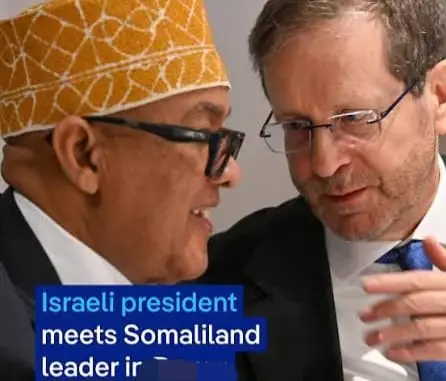
Israel’s political direction is therefore relevant to Somaliland’s wider interests in Red Sea security, regional stability, maritime cooperation and international diplomacy.
Relations between Hargeisa and Tel Aviv have attracted increasing regional and international attention after Israeli officially recognized Somaliland’s sovereignty on 25 December, 2025.
Any change in Israel’s political leadership could create new diplomatic considerations for Hargeisa, particularly as Somaliland continues to seek stronger international partnerships and recognition of its sovereignty.
However, there is currently no indication that Eisenkot has announced a specific policy towards Somaliland. His potential appointment should therefore be viewed as a political development worth monitoring rather than evidence of an immediate change in bilateral relations.
A changing Middle East and Somaliland’s diplomatic interests
The political transition in Israel comes at a time when the Red Sea and the wider Middle East are becoming increasingly important to international security and economic interests.
For Somaliland, the priority should be to maintain a consistent foreign policy based on national interests, economic cooperation, maritime security and long-term diplomatic partnerships.
Rather than depending on individual political leaders in foreign countries, Somaliland needs to build relationships with institutions, political parties and governments across different administrations.
Whether Eisenkot succeeds in forming a government or Netanyahu eventually returns to power, Israel’s future approach to the region will remain an important issue for Somaliland to follow.

