

China’s growing military engagement with Somalia isn’t happening in isolation—it sits at the intersection of Beijing’s global strategy, regional geopolitics in the Horn of Africa, and its rivalry with Taiwan. Somaliland plays a surprisingly strategic role in this triangle.
China views Somalia as part of a critical maritime corridor linking the Red Sea and Indian Ocean. Stability here protects shipping lanes tied to the Belt and Road Initiative.
The Horn already hosts multiple foreign military presences, especially in Djibouti. China has its first overseas base there and wants to expand influence beyond Djibouti into Somalia proper—training forces, donating equipment, and building defense ties.
China supports Somalia’s federal government as the internationally recognized authority. Military aid strengthens that relationship and ensures Mogadishu backs Beijing diplomatically—especially on sensitive issues like Taiwan.
China’s core foreign policy principle is isolating Taiwan diplomatically. Any region or entity engaging Taiwan becomes strategically important.
Somalia firmly supports the “One China” policy and has no ties with Taiwan. Strengthening Somalia militarily and politically reinforces that stance and prevents Taiwan from gaining any foothold there.
A Strategic Region Under Global Competition
The Horn of Africa sits along one of the world’s most vital maritime corridors, linking the Red Sea to the Indian Ocean. For China, whose economy depends heavily on global trade, securing these routes is a strategic imperative tied to the Belt and Road Initiative.
China’s presence in the region is already well established, particularly in Djibouti, where it operates its first overseas military base. However, Beijing’s increasing military cooperation with Somalia—through training programs, equipment support, and defense agreements—signals a shift toward deeper involvement inside Somalia itself.
This expansion is not merely about combating insecurity or piracy. It reflects a calculated effort to strengthen China’s influence in a region where global powers, including the United States and regional actors, are actively competing for strategic advantage.
Below is an article written by The Conversation:
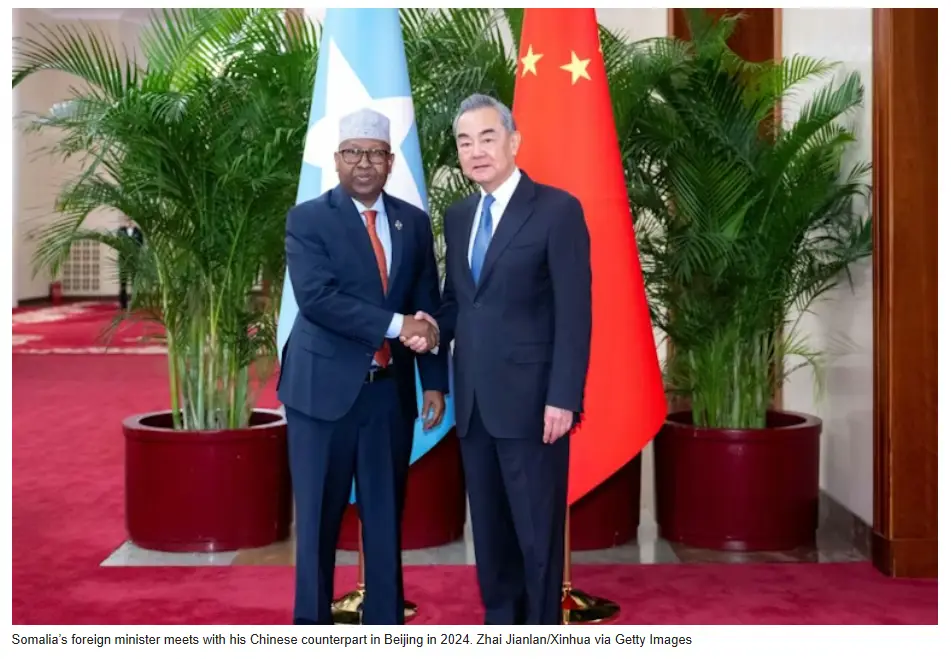 What form does China’s support in Somalia take?China’s interests in Somalia take two paths.
The first is broadly geopolitical. It relates to China’s long-standing interests in the Horn of Africa as a strategic crossroads. The region links the Indian Ocean to the Red Sea and the Mediterranean. The Horn of Africa includes Djibouti, Ethiopia, Somalia, Eritrea and Somaliland. Sudan and Kenya are important actors in the region’s affairs.
Beijing’s priorities here are about expanding political influence and embedding itself in regional security architectures. This explains its existing military presence in Djibouti and infrastructure investments across Ethiopia, as well as neighbouring states like Kenya, Uganda and South Sudan.
The second path is specific to Somalia. It is mainly shaped by China’s domestic politics and stance on Taiwan. Beijing considers Taiwan a breakaway province, and is concerned that Somaliland’s ties with Taipei could lend legitimacy to separatist movements. Somaliland is a de facto independent state that left its voluntary union with Somalia in 1991, and diplomatically recognised Taiwan in 2020.
To understand this Somalia-specific dynamic, it is necessary to look at what China’s support to Somalia entails. Beijing provides diplomatic backing, development assistance and, more recently, security cooperation framed around counterterrorism and support for Somalia’s fight against al-Shabaab militants.
Even so, China’s economic footprint remains modest. Unlike neighbouring Ethiopia, where Beijing has financed railways, ports and airports, Somalia has not received large-scale Belt and Road infrastructure.
Chinese engagement is, therefore, better understood as selective and strategic rather than transformative.
What are the strategic interests driving this engagement?
China is increasingly involved in Somalia because of Somaliland’s diplomatic recognition of Taiwan and its progress in pushing for its own international recognition.
Since 1949, Taiwan has been an independent, self-governing state, though the People’s Republic of China lays claim to the island.
Beijing has worked over the past three decades to isolate Taiwan diplomatically. It’s offered development, technology and infrastructure assistance in exchange for states severing diplomatic relations with Taipei.
As of 2026, only Eswatini and Somaliland in Africa maintain some form of diplomatic relations with Taiwan.
From Beijing’s perspective, the fact that a small, de facto independent state in the Horn of Africa had the temerity to exchange diplomats with Taiwan was bad enough. When Israel became the first state to formally recognise Somaliland’s independence in December 2025, Beijing reaffirmed its support for Somalia’s sovereignty and territorial integrity. US policymakers are also pushing to recognise Somaliland.
China and Somalia’s leaders in Mogadishu frequently affirm their support for “One Somalia” and “One China”, respectively. In their view, Somaliland must submit to Mogadishu’s rule. Ditto for Taiwan: it must join the People’s Republic of China.
Neither Somaliland nor Taiwan wish to be part of what they view as broken political experiments.
Their larger, angry neighbours don’t care. They resort to bullying and threaten violence – in different ways.
China has wealth, economic power and a global profile. It also has a huge military and growing navy, much of it tailormade to invade Taiwan. Despite this, Taiwan still prefers to go it alone, with support from the United States, Japan, Australia and others.
Mogadishu, on the other hand, is unable to exercise legitimate control over much of its own territory. Despite decades of external security assistance and military training, Somalia still has no capable military. The national army continues to underperform against al-Shabaab and remains entangled in clan-based politics.
Failure to shift the status quo in either Taiwan or Somaliland unites China and Somalia against smaller, weaker entities.
How does China’s approach in the Horn of Africa differ from that of western actors?
In my view, Beijing’s growing interest in Somalia is less about development corridors and more about political alignment, diplomatic positioning and security cooperation.
Western states have tended to emphasise counterterrorism operations, governance reforms and security sector training. Other actors like Turkey and the United Arab Emirates have combined military engagement with infrastructure investment and commercial interests, sometimes becoming deeply embedded in Somalia’s internal politics.
China, by contrast, has focused on regime support to reinforce Somalia’s territorial integrity. This assistance has been less overtly military, and is closely tied to diplomatic objectives.
China prefers building technological and institutional dependencies – in telecommunications, technology and surveillance, for example – across much of Africa.
In both the short and long term, greater Chinese involvement risks adding another layer of geopolitical competition in an already fragile region. Rather than acting as a stabilising force, Beijing may find itself drawn into the same local dynamics that have frustrated other external actors.
Somaliland, in comparison, has developed a relatively functional security sector and a high degree of domestic political legitimacy.
What could greater Chinese involvement mean for Somalia’s security?
There is little reason to expect China’s military assistance to succeed where others have failed. Its broader impact will likely be political rather than operational.
Increased Chinese backing for Mogadishu could deepen internal divisions within Somalia. It may intensify competition over territory, authority and external patronage.
Nowhere is this dynamic more visible than in Las Anod, a contested city in eastern Somaliland.
It has recently become the focal point of a new political entity – SSC Khatumo, armed by external state actors, including China, according to reports. It is backed by Mogadishu and viewed by Somaliland as illegitimate.
Political developments in Las Anod have taken on geopolitical overtones. Abdikhadir Firdhiye was inaugurated in January 2026 as the first president of what Mogadishu has recognised as its Northeast State. The SSC Khatumo administration considers Las Anod its capital.
Among those attending Firdhiye’s inauguration were ambassadors from Turkey, Saudi Arabia, China, Djibouti and Sudan. Their interests extend well beyond local governance.
For Somaliland, the message was clear: its bid for independence is now entangled in a much wider geopolitical contest.