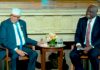

Michael Rubin’s criticism of Ambassador Ervin Massinga highlights the gap between Trump’s remarks and Washington’s formal position on Somaliland’s sovereignty.
Hargeisa (SLpost)- A renewed debate over Somaliland’s international recognition has emerged following comments by U.S. Ambassador to Ethiopia Ervin Massinga that Washington’s policy on Somaliland remains unchanged, prompting criticism from American foreign policy analyst Michael Rubin.
In an article published by the Washington Examiner on October 22, Rubin argued that Massinga’s remarks appeared to contradict President Donald Trump’s recent description of Somaliland as a country distinct from Somalia. He called on Trump to remove the ambassador, alleging that his intervention undermined the president’s position.
The controversy has brought renewed attention to Somaliland’s diplomatic campaign, the strategic importance of its position along the Gulf of Aden and the question of whether Washington will reconsider its longstanding policy toward the self-governing republic.
Ambassador Massinga’s remarks
In an interview with the Ethiopian publication The Reporter, Massinga was asked whether Trump’s description of Somaliland as a separate country represented a positive signal toward American recognition or remarks that did not reflect a policy change.
“There has been no change in United States policy,” Massinga responded.
He also cautioned against what he described as misinformation circulating on social media, urging audiences to verify sources and facts before drawing conclusions.
Michael Rubin, who is the director of policy analysis at the Middle East Forum, interpreted the ambassador’s response as an attempt to diminish the significance of Trump’s remarks and argued that the statement could discourage expectations of a shift in American policy.
The distinction is significant for Somaliland, whose diplomatic campaign has long sought to turn international political engagement into formal recognition after Israel became the first UN-member country to recognise its sovereignty on 25 December, 2025.
Somaliland’s recognition campaign gains renewed attention
Trump’s comments earlier in October attracted considerable attention in Somaliland, where officials welcomed his description and people in Hargeisa held celebratory gatherings in the streets waving U.S. and Somaliland flags.
In its response, Somaliland’s Ministry of Foreign Affairs and International Cooperation highlighted the republic’s separate political identity, established governing institutions, constitutional framework and record of self-government.
Somaliland restored its independence on May 18, 1991, following the collapse of Somalia’s central government. Its sovereignty is grounded in its independence from Britain on June 26, 1960, before entering a union with the Italian-administered territory of Somalia.
For more than three decades, Somaliland has operated its own government and security institutions while pursuing international recognition.
In September 2026, President Abdirahman Mohamed Abdullahi (Irro) visited Washington, where he engaged with American officials and policy institutions. His administration has sought to strengthen relations with the United States through cooperation in regional security, trade, investment and maritime affairs.
The president also presented Somaliland’s case at the Council on Foreign Relations in New York, arguing that its record of self-governance and stability provides a basis for international recognition.
These engagements have increased the visibility of Somaliland’s position in American policy discussions.
Berbera and the strategic importance of Somaliland
Beyond the diplomatic dispute, Rubin’s argument centres on the strategic interests the United States could pursue through closer relations with Somaliland.
The Horn of Africa country occupies a position along the Gulf of Aden, near the Bab el-Mandeb Strait, a critical maritime passage connecting the Red Sea with the Gulf of Aden and the wider Indian Ocean
Berbera Port and its associated airport and transport corridor are central to Somaliland’s efforts to attract international investment and develop its role in regional trade and security.
Rubin argues that these facilities could offer Washington additional strategic options at a time when competition among major powers is increasingly significant in the Horn of Africa and the Red Sea region.
China’s military presence in neighbouring Djibouti and the security challenges affecting international shipping have contributed to wider debate about American access, maritime security and regional partnerships.
For Somaliland, these issues provide an opportunity to frame recognition not only as a question of historical and political legitimacy but also as a potential contribution to shared international interests.
Debate over the ambassador’s intervention
Rubin’s demand for Massinga’s removal represents a more confrontational interpretation of the dispute.
His argument rests on the view that the ambassador’s public statement undermined the significance of the president’s comments and potentially discouraged a reconsideration of existing policy.
An alternative interpretation is that Massinga was explaining the administration’s established position in response to a direct question about whether Trump’s remarks signalled a policy change.
Ambassadors routinely communicate official policy, although the precise scope of their authority and the instructions governing individual statements depend on the circumstances.
What the debate means for Somaliland
The disagreement highlights a central challenge facing Somaliland’s foreign policy: converting growing political visibility into tangible diplomatic outcomes.
Statements by prominent American officials, meetings with congressional representatives and discussions of strategic cooperation can strengthen Somaliland’s international profile.
Somaliland’s quest for recognition has been consistently based on its historical status, established institutions, record of self-government and capacity to contribute to regional stability.
Its diplomatic engagement with Washington also reflects a broader effort to establish partnerships based on shared interests rather than relying exclusively on appeals for recognition.
The current debate may provide additional opportunities for Somaliland to communicate its position to American policymakers.