

Addis Ababa (SLpost)- Ethiopia is confronting an increasingly complex security crisis as a newly formed alliance of armed groups challenges the federal government, while tensions with Eritrea and accusations involving Egypt and Sudan add a broader regional dimension to the conflict.
The development comes as fighting has intensified in northern Ethiopia and former adversaries have joined forces in an alliance seeking to remove Prime Minister Abiy Ahmed’s government.
Seven Ethiopian armed and political groups announced this week the formation of the Ethiopian Peoples’ Forces Alliance for Survival, bringing together factions from several regions, including the Tigray People’s Liberation Front (TPLF), the Amhara Fano National Movement and the Oromo Liberation Army. The coalition has said it seeks to establish an inclusive transitional government.
The alliance is particularly notable because some of its members previously fought on opposing sides during Ethiopia’s 2020–2022 Tigray war.
Ethiopian Army Chief Accuses Foreign Powers
Ethiopian military chief Field Marshal Birhanu Jula has now accused foreign powers of supporting the emerging alliance as part of an effort to destabilise the country.
Speaking through the Ethiopian military’s media outlet, Birhanu alleged that Ethiopia’s adversaries had shifted from direct confrontation to supporting internal conflicts through financing, intelligence operations and other forms of assistance.
He specifically claimed that Eritrea was acting as an intermediary between external powers and armed groups inside Ethiopia, and said that the TPLF and Eritrea could not independently challenge the federal government without outside support.
“Neither Shaebia nor the TPLF can achieve anything alone – even if combined – unless pushed, supported, and supplied by Sudan, Egypt, and powers beyond,” Birhanu said, according to Addis Standard.
The allegations represent the Ethiopian government’s latest assertion that the country’s internal conflicts are being influenced by regional powers. Eritrea has repeatedly rejected previous accusations that it supports Ethiopian insurgent groups.
There was no immediate independent evidence presented publicly to substantiate Birhanu’s specific allegations regarding Egyptian or Sudanese military or intelligence support.
Former Enemies Unite Against Addis Ababa
The emergence of the new coalition marks a significant development in Ethiopia’s fragmented security landscape.
The TPLF and Fano were previously on opposite sides of the devastating Tigray conflict. Fano forces fought alongside federal forces against the TPLF during the 2020–2022 war before subsequently turning against the federal government in Amhara.
The new alliance also includes groups from Oromia, Afar and Benishangul-Gumuz, creating a geographically dispersed coalition with different political and territorial interests.
That diversity could become both an advantage and a challenge.
While the groups share opposition to the federal government, their political objectives, territorial claims and organisational structures remain different. International Crisis Group analyst Magnus Taylor told Reuters that geographical distance, political differences and the relative weakness of some members could make effective coordination difficult.
Field Marshal Birhanu has made a similar argument, saying the groups face internal divisions that could prevent them from operating as a unified military force.
Eritrea at the Centre of the Regional Tensions
Eritrea occupies a particularly sensitive position in the emerging crisis.
Addis Ababa has accused Asmara of supporting Ethiopian opposition forces, while Eritrea has rejected such accusations. The latest allegations come against the backdrop of rapidly deteriorating relations between the two neighbours.
The renewed tensions are particularly significant because Ethiopia and Eritrea fought a major border war from 1998 to 2000 before relations dramatically improved following Abiy Ahmed’s 2018 peace initiative.
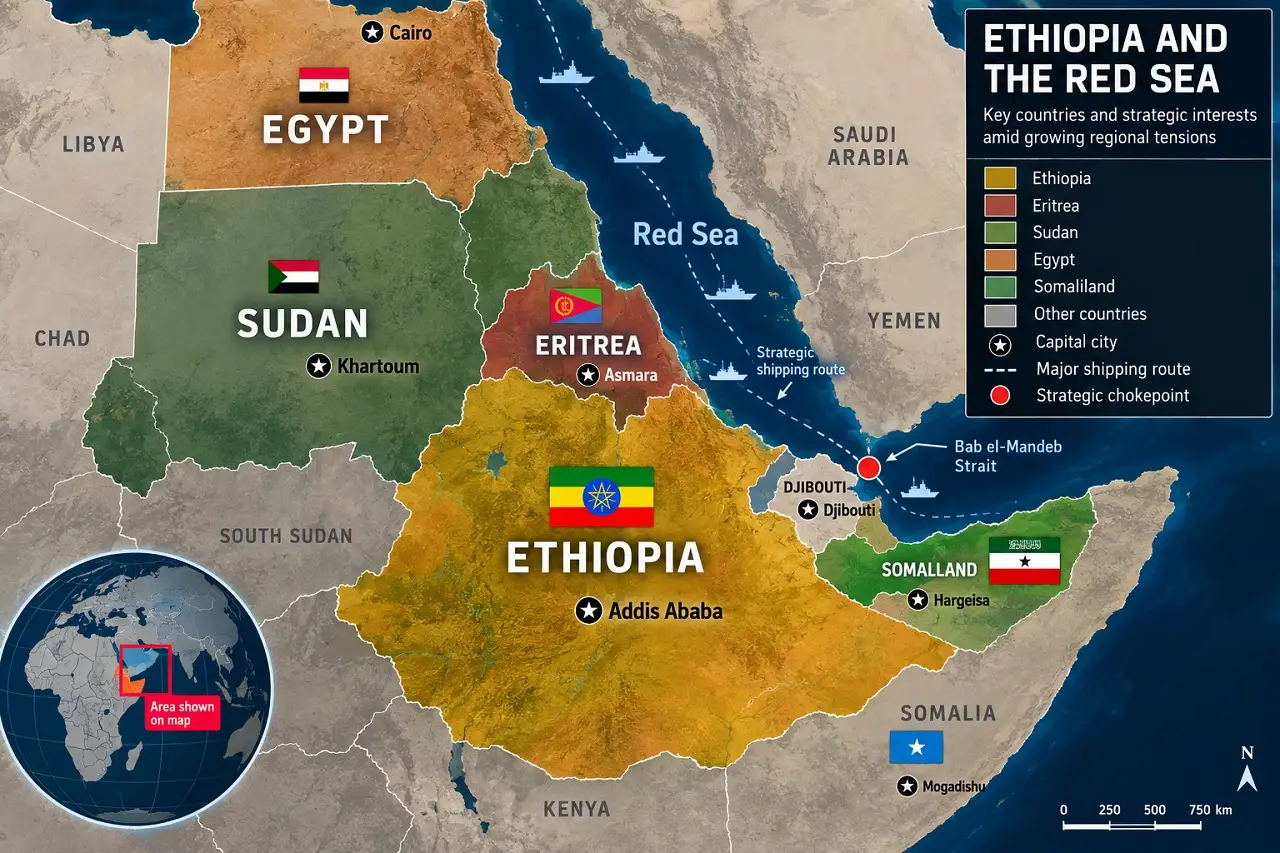
Egypt and Sudan: A Wider Strategic Dimension
The Ethiopian military’s allegations against Egypt and Sudan add another layer to an already complicated regional picture.
Relations between Ethiopia and Egypt have been strained for years by the dispute over the Grand Ethiopian Renaissance Dam (GERD) on the Blue Nile. Cairo has consistently expressed concerns about the dam’s impact on downstream water security.
Sudan, meanwhile, remains embroiled in its own devastating war and shares borders with both Ethiopia and Egypt. The instability in Sudan has created additional security concerns along Ethiopia’s western frontier.
Against this backdrop, Addis Ababa’s claim that Sudan and Egypt are providing support to forces opposed to the Ethiopian government places the country’s domestic conflict within a much broader regional security framework.
UAE Takes Position Against the Armed Alliance
While Addis Ababa has pointed to alleged support from Eritrea, Egypt and Sudan, the United Arab Emirates has taken a markedly different public position.
The UAE has strongly condemned recent attacks attributed to the TPLF and its armed allies, including the seizure of airports in Tigray and military escalation in Afar and Amhara.
Abu Dhabi said the developments threaten Ethiopia’s unity, sovereignty and stability, and expressed solidarity with the Ethiopian federal government and people.
UAE Minister of State Sheikh Shakhboot bin Nahyan Al Nahyan also rejected attempts to alter Ethiopia’s constitutional order through force or armed action and called for an immediate cessation of hostilities, protection of civilians and adherence to the Pretoria Peace Agreement.
The UAE’s position therefore places it publicly on the side of Ethiopia’s territorial integrity and against an armed attempt to change the country’s political order.
The Red Sea Question
Underlying many of these developments is a strategic issue that extends beyond Ethiopia’s internal politics: access to the Red Sea.
Ethiopia is landlocked but has repeatedly emphasised the strategic importance of obtaining reliable access to the sea. Its pursuit of maritime access has become one of the most consequential geopolitical issues in the Horn of Africa.
The issue became particularly prominent after Ethiopia signed a memorandum of understanding with Somaliland in January 2024 concerning access to the Red Sea, triggering strong opposition from Somalia and increasing regional diplomatic tensions.
The renewed confrontation involving Tigray, Eritrea and the federal government therefore cannot be separated entirely from the wider strategic competition surrounding the Red Sea and the Gulf of Aden.
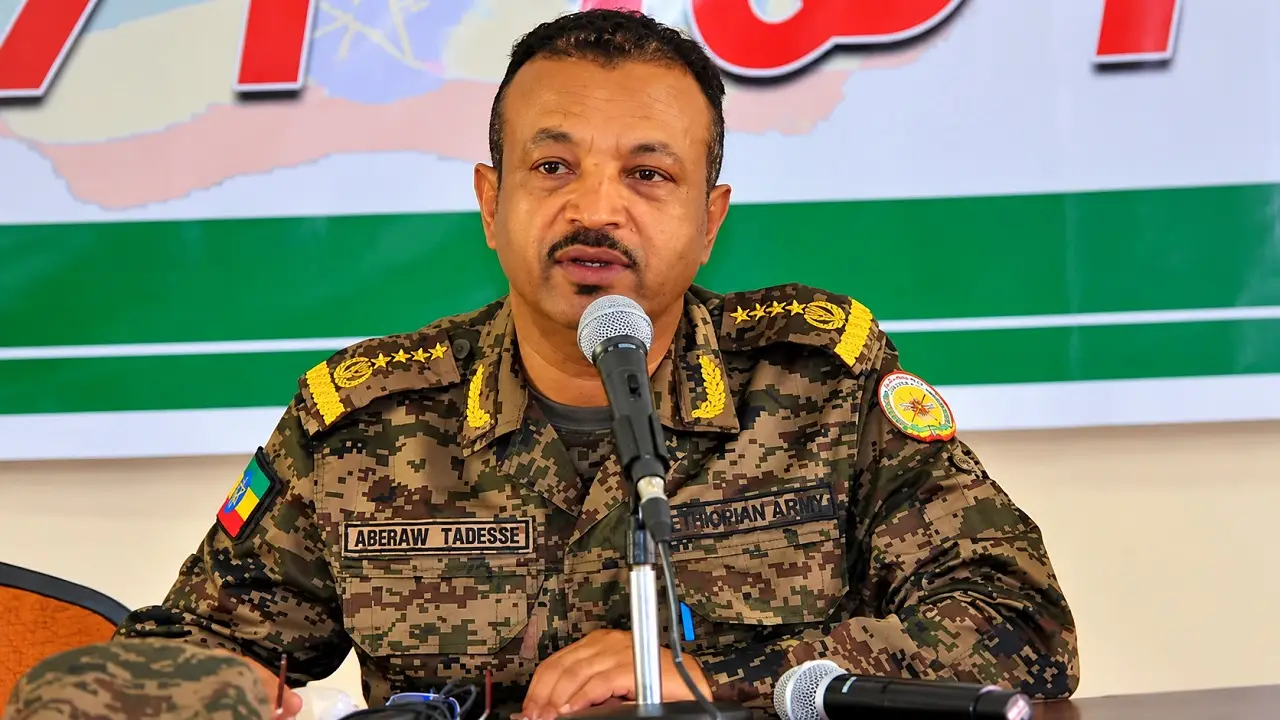
“We Will Stop at the Red Sea”
The rhetoric coming from Ethiopia’s military leadership has further underscored the importance of the maritime question.
General Abebaw Tadesse, Deputy Chief of the General Staff of the Ethiopian National Defense Force, was quoted as saying that the armed forces were currently operating defensively across multiple fronts but were preparing both ground and air forces for offensive operations.
He reportedly added that once the military launched its offensive, “we will stop at the Red Sea.”
The statement is significant because it links Ethiopia’s military calculations with the country’s longstanding strategic interest in Red Sea access.
It also comes at a moment when the region is already experiencing overlapping conflicts and rivalries involving Ethiopia, Eritrea, Sudan, Egypt and the wider Red Sea security environment.
A Conflict No Longer Confined to Ethiopia?
The formation of the new armed alliance, the renewed fighting in Tigray, accusations involving Eritrea, Egypt and Sudan, and the UAE’s explicit backing of Ethiopia’s sovereignty are creating an increasingly interconnected regional security picture.
At the domestic level, the central question is whether the seven-group alliance can overcome its internal political and territorial differences and function as a coordinated force.
At the regional level, the more consequential question is whether Ethiopia’s internal conflict becomes increasingly entangled with the rival strategic interests of neighbouring states.
For now, the competing claims remain sharply disputed. Ethiopia says external actors are helping its armed opponents; Eritrea rejects accusations of supporting insurgents; and there is no independently established public evidence confirming all of Addis Ababa’s allegations against Egypt and Sudan.
What is clear, however, is that Ethiopia’s security crisis is unfolding alongside renewed tensions in Tigray, deteriorating relations with Eritrea and an increasingly contested geopolitical environment around the Red Sea.
The developments have therefore transformed what might otherwise have been viewed primarily as an internal Ethiopian conflict into a crisis with potential implications for the wider Horn of Africa and Red Sea security architecture.
Reporting by Somalilandpost News and Agencies

