
Hargeisa (SLpost) – The Central Bank of Somaliland has welcomed discussions in Washington concerning Somaliland’s access to the U.S. and international financial systems, describing stronger financial connectivity as an important priority for the country’s economic development.
The Bank’s response comes a day after U.S. lawmakers examine the Somaliland Economic Access and Opportunity Act (H.R. 7993), legislation that would require the U.S. Treasury Department to assess barriers affecting Somaliland’s access to the U.S. financial system and make recommendations to Congress.
The bill was introduced on March 19, 2026, by Representative John W. Rose, alongside Representatives Andrew Ogles and Pat Harrigan, and was referred to the House Financial Services Committee. The proposed legislation does not itself grant Somaliland access to the U.S. financial system or SWIFT. Instead, it establishes a framework for a Treasury assessment of the legal, regulatory and policy barriers involved.
A Broader Financial-Sector Reform Agenda
The Washington discussion comes as Somaliland’s Central Bank has been pursuing reforms aimed at strengthening the country’s domestic financial architecture.
The Bank has been advancing risk-based supervision, an approach that allows financial regulators to concentrate supervisory resources according to the risks posed by individual institutions and activities. The reform is part of a broader effort to strengthen regulatory oversight, financial stability and compliance within Somaliland’s banking sector.
The Central Bank has also developed financial-sector cooperation with Taiwan, including engagement with Taiwan’s Central Deposit Insurance Corporation (CDIC) on deposit-insurance and related institutional capacity. Such cooperation forms part of Somaliland’s efforts to strengthen confidence, resilience and consumer protection within its financial system.
Taken together, these domestic reforms provide important context for the current discussion in Washington, where financial access is being considered alongside regulatory compliance and safeguards against illicit finance.
What H.R. 7993 Would Examine
H.R. 7993 directs the Treasury Secretary to examine barriers affecting Somaliland’s access to the U.S. financial system.
Among the issues specifically identified are Somaliland’s international recognition status and its compliance with financial-sector standards, including Know Your Customer (KYC), anti-money laundering (AML), and counter-terrorist financing (CTF) requirements.
The proposed Treasury assessment would also examine challenges affecting remittance flows, an important component of Somaliland’s connection with the global economy. The legislation calls for recommendations on mechanisms and technologies that could help prevent money laundering, terrorism financing and other illicit activities associated with remittances and U.S. financial-system access.
The bill also calls for consideration of Somaliland’s engagement with international financial institutions, including the International Monetary Fund and World Bank, as well as relevant international financial standards.
SWIFT and International Financial Connectivity
One of the more specific elements of H.R. 7993 concerns the SWIFT financial messaging system.
The bill would require Treasury to assess the steps necessary for Somaliland to potentially be incorporated into SWIFT’s financial messaging and payment infrastructure.
That provision does not amount to SWIFT membership or access. Rather, it would require the U.S. Treasury to identify the requirements and potential steps associated with such integration.
The introduced legislation also does not expressly use the term “correspondent banking.” Accordingly, the broader issue is more accurately described as Somaliland’s access to international financial institutions, payment systems and financial channels.
Potential Significance for Remittances and the Private Sector
Greater international financial connectivity could affect a range of economic activities, including remittances, cross-border payments, trade and investment.
For households receiving money from relatives abroad, more efficient financial channels could potentially reduce transaction friction. For businesses, stronger links to international financial institutions could facilitate payments to suppliers, customers and service providers outside Somaliland.
The Central Bank has nevertheless emphasized that increased access must be accompanied by strong regulatory controls, transparency, effective supervision and safeguards against illicit financial activity.
That emphasis is consistent with the direction of the Bank’s domestic regulatory reforms, including its move toward risk-based supervision and efforts to strengthen the resilience and credibility of Somaliland’s financial sector.
Treasury Report Would Follow Enactment
Under H.R. 7993, the Treasury Secretary would be required to submit the comprehensive assessment to the House Committee on Financial Services and the Senate Committee on Banking, Housing, and Urban Affairs within 180 days after the legislation is enacted.
The report would address barriers to financial access and include recommendations concerning steps Somaliland could take to strengthen compliance with international financial standards, as well as possible measures the United States could take to facilitate greater financial engagement.
The legislation would also permit Treasury to engage with Somaliland institutions, including the Central Bank of Somaliland, Ministry of Finance and Economic Development, Ministry of Foreign Affairs and International Cooperation, and Office of the Economic Advisor to the President, as part of the assessment process.
Central Bank Ready for Technical Engagement
The Central Bank said it is prepared to provide the U.S. Treasury and other relevant institutions with objective and verifiable information about Somaliland’s financial system and to participate constructively in any technical engagement arising from the process.
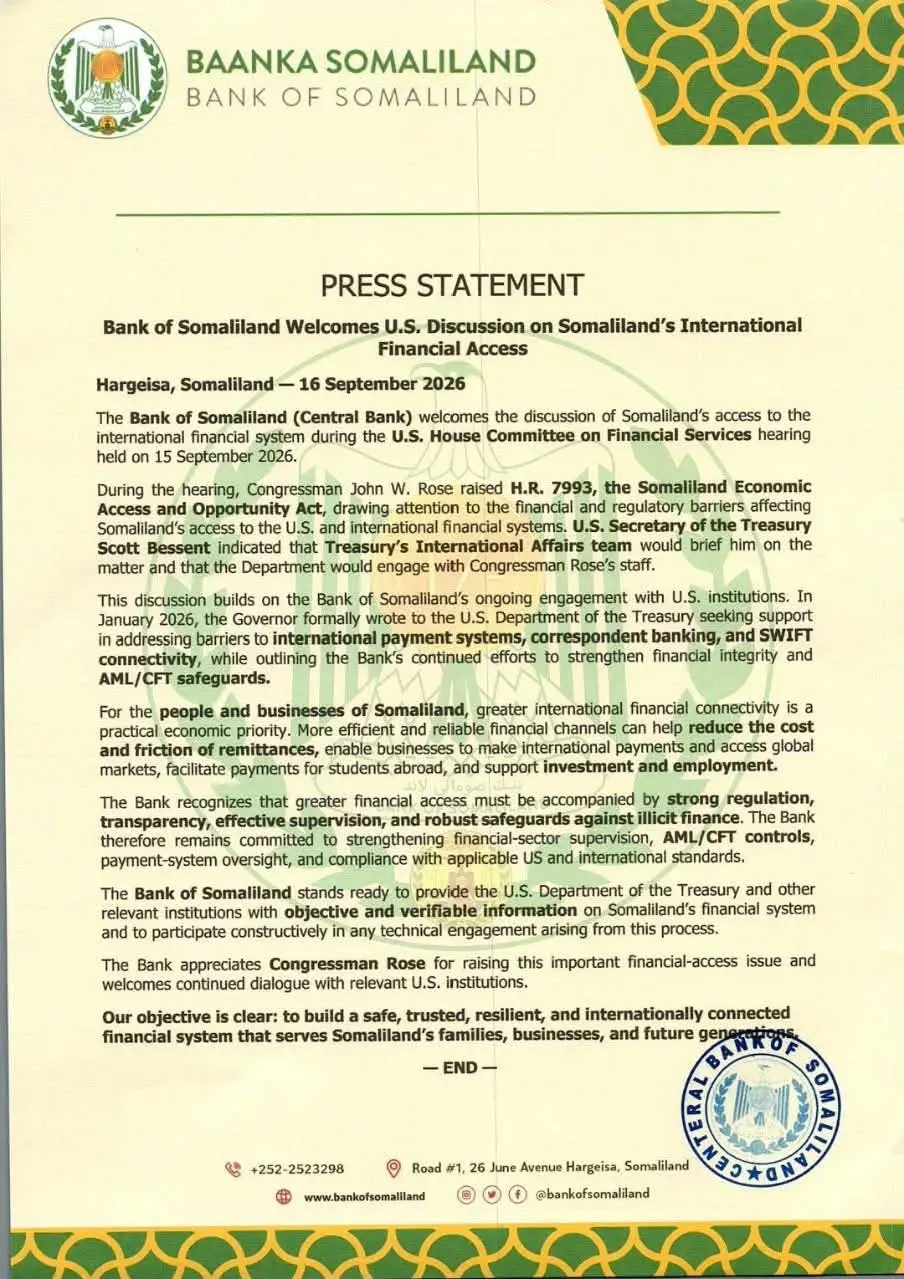
The Bank welcomed Congressman Rose’s efforts to raise the issue of Somaliland’s financial access and said it would continue dialogue with relevant U.S. institutions.
“Our objective is clear: to build a safe, trusted, resilient, and internationally connected financial system that serves Somaliland’s families, businesses, and future generations,” the Bank said.
H.R. 7993 remains a proposed bill rather than enacted legislation. Its significance at this stage is therefore centered on the proposed congressional direction for the Treasury Department to undertake a formal assessment of the barriers and possible pathways associated with Somaliland’s international financial access.
Report By Somalilandpost News

