

Somaliland president highlights international recognition, Red Sea security, Berbera Port and democratic governance as key areas for closer cooperation with Washington
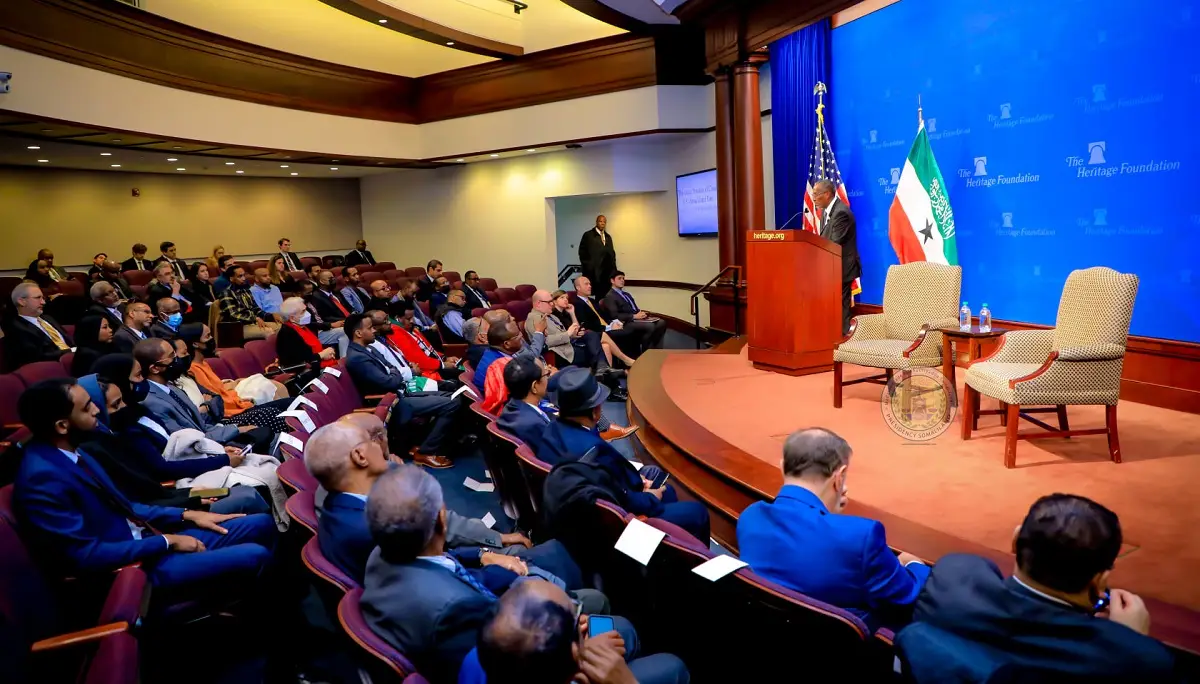
WASHINGTON, March 14, 2022 — Somaliland President Muse Bihi Abdi addressed at the Heritage Foundation in Washington, D.C., to make the case for stronger relations between Somaliland and the United States, arguing that Somaliland’s political stability, strategic location and economic potential offered opportunities for closer bilateral cooperation.
In his address to the US public policy institution, Bihi discussed Somaliland’s historical independence, its experience of state-building since 1991, the security challenges facing the Horn of Africa and the strategic importance of the Red Sea and Gulf of Aden. He also called for a permanent US diplomatic presence in Hargeisa and deeper cooperation in security, trade and democratic governance.
The speech presented Somaliland’s pursuit of international recognition as both a historical question and a matter of contemporary regional security and economic interests.
Somaliland’s historical case for independence
Bihi traced Somaliland’s independence claim to June 26, 1960, when the former British Somaliland Protectorate gained independence and received international recognition before voluntarily entering into union with the former Italian-administered territory of Somalia.
He argued that the union subsequently failed to deliver the political equality and national unity its supporters had envisaged. He cited the centralisation of power, political repression and the violence inflicted on Somaliland during the rule of Somalia’s military government as central elements of the territory’s case for restoring its independence.
The president recalled the destruction of Hargeisa and other northern towns during the conflict of the late 1980s, as well as the resulting deaths, displacement and refugee crisis. He drew a comparison with the suffering of civilians in Ukraine, which was facing a full-scale Russian invasion at the time of his address.
Following the collapse of Somalia’s central government in 1991, Somaliland reasserted its independence and began rebuilding its political institutions. Bihi argued that the subsequent development of a functioning administration, security institutions and electoral processes demonstrated Somaliland’s capacity to govern itself.
He also referred to the African Union fact-finding mission’s 2005 assessment of Somaliland’s recognition claim, which he presented as support for the argument that the territory’s historical circumstances were distinct from those of other secessionist movements.
Why Somaliland matters to US strategic interests
A central theme of Bihi’s address was the changing geopolitical significance of the Horn of Africa. He argued that regional instability, the activities of extremist groups and intensifying international competition had increased the strategic value of reliable partners along the Gulf of Aden and the Red Sea.
The Bab el-Mandeb Strait, which connects the Red Sea to the Gulf of Aden and forms a critical maritime passage between Europe and Asia, featured prominently in his argument. The waterway is important for international shipping and energy transportation, making maritime security a shared concern for countries that depend on these routes.
Bihi argued that Somaliland’s relative stability and experience in coastal security could contribute to efforts to counter piracy, prevent illicit trafficking and protect commercial shipping.
He also questioned the effectiveness of international efforts to stabilise Somalia, arguing that extensive external assistance had not produced the political and security outcomes anticipated by its international partners. These assessments represented the Somaliland government’s position and should be understood in the context of the continuing political dispute between Hargeisa and Mogadishu.
His broader argument was that Washington could pursue its regional interests through more direct engagement with Somaliland, rather than treating relations with Hargeisa exclusively through its established relationship with the federal government in Mogadishu.
Berbera Port and the economic dimension
The president also highlighted Berbera Port as a potential gateway for regional commerce and an asset for international logistics.
At a time when the port was undergoing expansion under DP World’s investment programme, Bihi pointed to the development of port infrastructure, improvements to transport connections and the potential for greater trade with neighbouring markets as opportunities to strengthen Somaliland’s economic position.
He argued that Berbera could support commercial shipping, humanitarian logistics and regional connectivity while providing an additional route linking the Horn of Africa to international maritime networks.
For Washington, closer economic engagement with Somaliland could, in principle, complement wider interests in supply-chain resilience, maritime security and commercial access to East African markets. However, translating these potential benefits into policy would require concrete investment decisions, commercial agreements and government-to-government engagement.
A call for a permanent US diplomatic presence in Hargeisa
One of the address’s clearest proposals was the establishment of a permanent US diplomatic presence in Hargeisa.
Bihi argued that a US presence would enable more regular political dialogue, facilitate cooperation on security and development, and provide a framework for closer engagement between American institutions and Somaliland’s government.
He cited previous contacts between Somaliland officials and US counterparts, including visits by Somaliland’s foreign minister to Washington and a visit to Hargeisa by a delegation of senior US congressional staff.
The president also called for cooperation on maritime security, counterterrorism, governance and democratic institution-building. He presented Somaliland’s experience with elections, voter registration and peaceful transfers of power as areas in which it could share practical experience with international partners.
At the same time, he acknowledged that Somaliland’s democratic institutions still required improvement, including measures to expand women’s participation in political life.
The proposed diplomatic presence was therefore framed not simply as a symbolic step towards recognition, but as a practical mechanism for developing a more sustained bilateral relationship.
Somaliland–Somalia dialogue and the recognition question
Bihi addressed the longstanding dialogue between Somaliland and Somalia, which began under an internationally supported framework in 2012.
He argued that successive rounds of talks had failed to resolve the fundamental disagreement over Somaliland’s political status. While some discussions had addressed technical matters, he maintained that they had not produced a political settlement on the central question of sovereignty.
The president attributed the lack of progress to the Somali government’s approach to the negotiations and argued that Somaliland should be free to pursue other avenues towards international recognition.
This position reflected the Somaliland government’s assessment of the dialogue process. Somalia’s federal government, by contrast, has maintained its claim to Somaliland as part of Somalia. The competing positions remain at the heart of the dispute over the territory’s international status.
Bihi urged the international community to engage directly with Somaliland and argued that recognition would enable it to contribute more effectively to regional stability, trade and security.
The broader significance of the address
The Heritage Foundation speech set out a strategy for presenting Somaliland to US policymakers through a combination of historical claims, democratic governance, economic opportunity and shared security interests.
Rather than relying exclusively on arguments about historical sovereignty, Bihi sought to demonstrate how closer relations with Somaliland could serve practical American interests in the Horn of Africa and the wider Red Sea region.
His call for a permanent US diplomatic presence in Hargeisa was particularly significant because it offered a concrete step towards institutionalising engagement, even in the absence of a formal decision on recognition.
The address did not establish a change in US policy, nor did it amount to a commitment by the Heritage Foundation or the US government to recognise Somaliland. Instead, it articulated the Somaliland administration’s case for a more direct relationship with Washington and identified areas where the two sides might find common interests.
For Somaliland, the central challenge remains converting strategic relevance, diplomatic advocacy and domestic institution-building into formal international recognition and durable bilateral partnerships.