


Somalia under President Hassan Sheekh Mohamud is governed not through hierarchical sovereignty, but through selective and performative authority shaped by external dependency. At the center of this governance failure lies 𝒕𝒉𝒆 𝒉𝒚𝒑𝒐𝒄𝒓𝒊𝒔𝒚 𝒐𝒇 𝑯𝒂𝒔𝒔𝒂𝒏 𝑺𝒉𝒆𝒆𝒌𝒉 𝒉𝒊𝒎𝒔𝒆𝒍𝒇 —a pattern in which he publicly denounces actions as violations of sovereignty while quietly accommodating, or remaining silent toward, far more expansive external demands. This hypocrisy is most clearly revealed through two linked cases: Hassan Sheekh’s Al Jazeera interview on Israel and Somalia’s response to the Ethiopia–Somaliland Memorandum of Understanding (MoU).
𝐈𝐬𝐫𝐚𝐞𝐥 𝐚𝐧𝐝 𝐃𝐢𝐩𝐥𝐨𝐦𝐚𝐭𝐢𝐜 𝐀𝐦𝐛𝐢𝐠𝐮𝐢𝐭𝐲
In an Al Jazeera interview, Hassan Sheekh stated:
“𝗜𝘀𝗿𝗮𝗲𝗹 𝗶𝘀 𝗮 𝗺𝗲𝗺𝗯𝗲𝗿 𝘀𝘁𝗮𝘁𝗲 𝗼𝗳 𝘁𝗵𝗲 𝗨𝗻𝗶𝘁𝗲𝗱 𝗡𝗮𝘁𝗶𝗼𝗻𝘀… 𝘄𝗲 𝗱𝗼 𝗻𝗼𝘁 𝗵𝗮𝘃𝗲 𝗿𝗲𝗹𝗮𝘁𝗶𝗼𝗻𝘀 𝗻𝗼𝘄, 𝗮𝗻𝗱 𝗽𝗲𝗿𝗵𝗮𝗽𝘀 𝘁𝗵𝗲𝗿𝗲 𝗺𝗮𝘆 𝗯𝗲 𝗿𝗲𝗹𝗮𝘁𝗶𝗼𝗻𝘀 𝘁𝗼𝗺𝗼𝗿𝗿𝗼𝘄.”
This statement is analytically decisive. While Mogadishu actively condemns Somaliland’s engagement with Israel as illegitimate, Hassan Sheekh simultaneously affirms Somalia’s own right to establish relations with Israel in the future. 𝑾𝒉𝒂𝒕 𝒊𝒔 𝒓𝒆𝒋𝒆𝒄𝒕𝒆𝒅 𝒇𝒐𝒓 𝑺𝒐𝒎𝒂𝒍𝒊𝒍𝒂𝒏𝒅 𝒊𝒔 𝒑𝒓𝒆𝒔𝒆𝒓𝒗𝒆𝒅 𝒇𝒐𝒓 𝑴𝒐𝒈𝒂𝒅𝒊𝒔𝒉𝒖, revealing hypocrisy rather than principle. Recognition is therefore not denied in substance, but selectively controlled.
𝐄𝐭𝐡𝐢𝐨𝐩𝐢𝐚, 𝐭𝐡𝐞 𝐒𝐨𝐦𝐚𝐥𝐢𝐥𝐚𝐧𝐝 𝐌𝐨𝐔, 𝐚𝐧𝐝 𝐭𝐡𝐞 𝐅𝐨𝐮𝐫-𝐏𝐨𝐫𝐭 𝐃𝐞𝐦𝐚𝐧𝐝
The same hypocrisy governs Somalia’s response to the Ethiopia–Somaliland MoU and Ethiopia’s broader maritime ambitions. The Somali Federal Government condemned the MoU as a violation of sovereignty and international law, yet no enforcement, arbitration, or deterrent measures followed.
More strikingly, Ethiopia has formally articulated a strategic demand for access 𝒕𝒐 𝒖𝒑 𝒕𝒐 𝒇𝒐𝒖𝒓 𝒑𝒐𝒓𝒕𝒔 𝒂𝒍𝒐𝒏𝒈 𝒕𝒉𝒆 𝑰𝒏𝒅𝒊𝒂𝒏 𝑶𝒄𝒆𝒂𝒏, a request that far exceeds the scope of the Somaliland MoU. Despite this unprecedented demand on Somali maritime space, Hassan Sheekh did not assert firm sovereign limits. Instead, he invited Prime Minister Abiy Ahmed to Mogadishu, engaging in high-level diplomacy without resolving the MoU, the four-port demand, or Ethiopia’s wider maritime agenda.
Here, sovereignty was weaponized against Somaliland but softened—if not suspended—when Ethiopia escalated its claims. Condemnation was selective; accommodation was strategic, exposing the core hypocrisy of Hassan Sheekh’s approach.
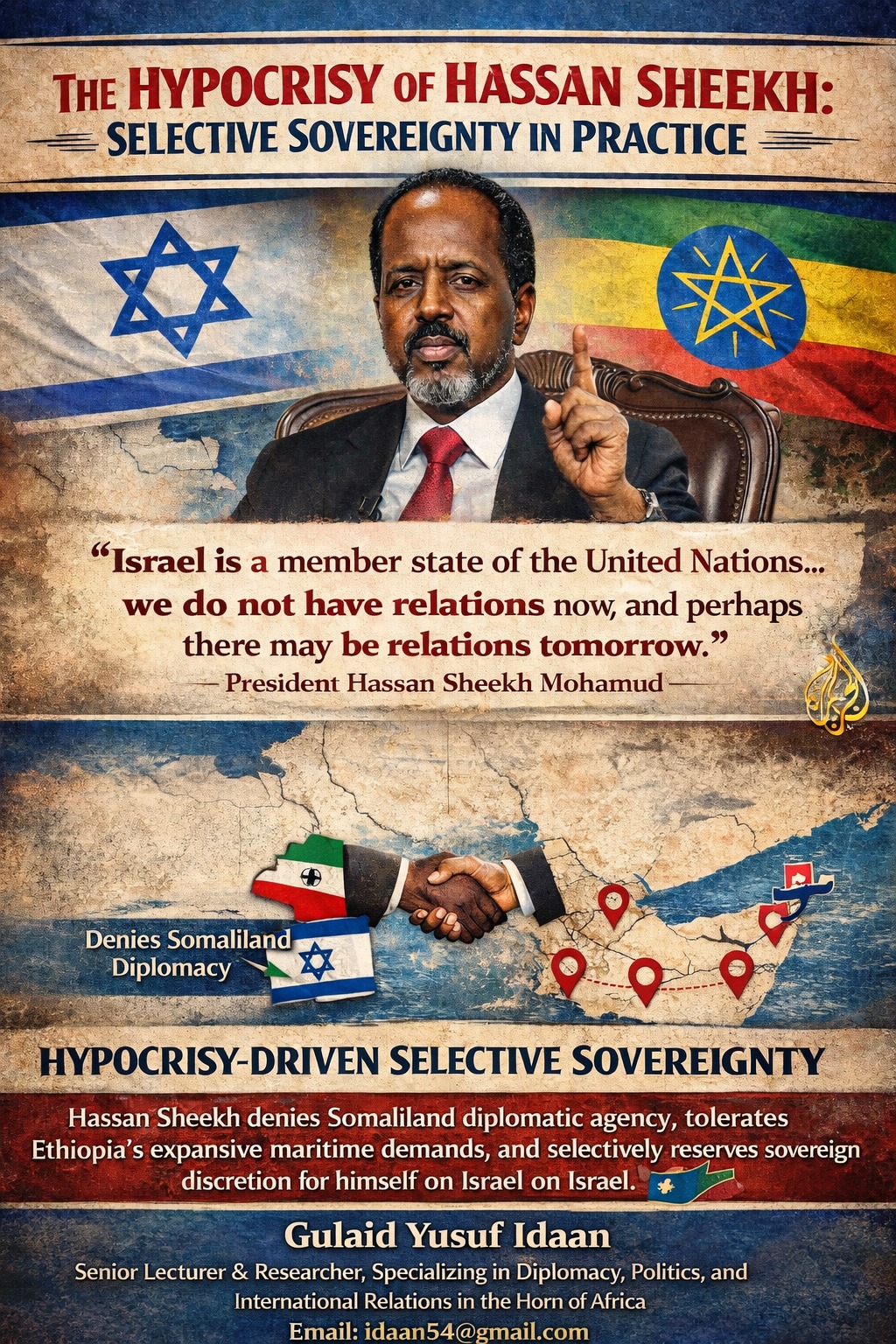 When read together, the Al Jazeera admission, the Somaliland MoU, and Ethiopia’s demand for four Indian Ocean ports reveal a governance pattern defined by hypocrisy-driven selective sovereignty. By denying Somaliland diplomatic agency, tolerating Ethiopia’s expansive maritime demands, and reserving sovereign discretion for himself on Israel, Hassan Sheekh embodies the contradiction at the heart of Somalia’s failed-state governance. This hypocrisy weakens Somalia’s claims to effective sovereignty and, by contrast, reinforces Somaliland’s position as a territorially governed and internally coherent de facto state.
Written by Gulaid Goohe Idaan

